
The history of Quonset huts dates back to World War II. Long before we shipped our first Quonset hut, metal building kit, or garage kit, the Navy was utilizing Quonset huts for a wide range of applications. Developed by armed forces personnel, these huts fulfilled the need for lightweight housing and storage that could be quickly assembled and disassembled in the field using just hand tools. They derived their name from the location of the first manufacturing facility, Quonset Point, at the Davisville Naval Construction Battalion Center in Rhode Island. In the years since, they’ve become one of the most popular options for residential, commercial, and agricultural needs.
Prior to manufacturing our first Quonset hut kit, the original design was quite different from the steel Quonset hut and metal building kits known today. Initially modeled after the semi-cylindrical Nissen hut developed by the British, creators Dejongh and Brandenberger modified the Nissen model into a structure containing wooden lining, insulation, and tongue and groove wooden flooring and, thus, the Steel Quonset hut model was born. These huts were adaptable and catered to an expansive set of needs, from showers and bakeries to dental offices and everything in between. One difficulty with this initial design arose from the fact that the steel Quonset hut kits were used for more than one purpose, and some required special layouts to accommodate showers, latrines, dental offices, bakeries, and isolation wards, to name a few, as well as all the equipment necessary for those additional uses.
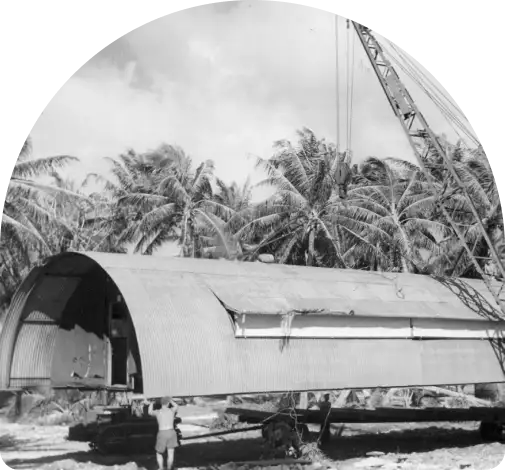
During World War II, the metal Quonset hut design underwent several modifications from its original semi-circular Nissen hut design. The final design was a structure with vertical side walls and a twenty-foot by forty-eight-foot interior living space. This design proved to be more space-efficient than tents with wooden doors and frames, making it an ideal choice for shipping and housing. Later, it was discovered that these huts could be used for purposes other than housing troops and materiel, so multiple interior designs were developed, and larger forty-foot by one-hundred-foot warehouses were introduced.
After the war ended, the United States Navy offered many of its surplus Quonset huts to the public for $1000 per hut, where many universities acquired them for student housing. Some of the returning soldiers even chose to purchase these steel buildings for their homes.
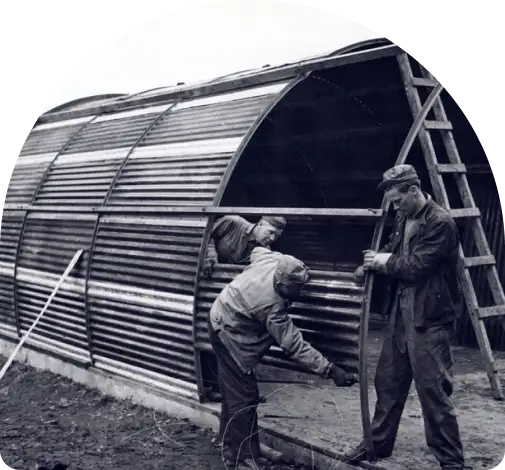
The Seabee Museum and Memorial Park in Davisville, Rhode Island serves as a testament to the history of Quonset huts. It pays tribute to the original Quonset hut factory in Davisville and celebrates the longstanding association between Quonset huts and the Seabees since World War II.
This historical display comprises around ten huts adjacent to the Museum parking lot and throughout Memorial Park. Beyond this homage, Quonset huts remain in use globally. For those interested in owning a piece of this legacy, Powerbilt offers Quonset metal buildings in different styles and sizes. Call +1 (800) 547-8335 to get a price today!
Connect with Our Quonset Building Experts Today!